Product Questions to Ask Your Session Replay Assistant

On this page
A session replay assistant is most useful when the question is specific enough for replay evidence to answer. “Why are users leaving?” is usually too broad. “Which signup visitors started the form, hit validation, and abandoned before submit?” gives the assistant a journey, a failed outcome, and observable behavior to search for.
The goal is not to write clever prompts. The goal is to ask questions that turn replay volume into a review set, repeated patterns, representative sessions, and a next action a product team can verify.
Use this guide with the AI session replay analysis workflow when the team needs AI-assisted replay review, and with Monolytics natural-language Record Search when the question needs repeated patterns across many sessions.
Last reviewed: July 1, 2026. This guide uses public workflow-level Assistant language only. Replay evidence can show observable behavior and context. It does not prove exact user motive, exact frustration, root cause, or business impact by itself.
What makes a replay question answerable
A good replay question includes five parts.
| Part | What to write | Example |
|---|---|---|
| Journey | The page, flow, or product path | Signup form, pricing page, onboarding setup |
| Failed outcome | What did not happen | Did not submit, did not start trial, did not finish setup |
| Observable behavior | What replay can actually show | Dead clicks, loops, hesitation, retries, exits |
| Segment | Which sessions should count | Mobile users, paid-search visitors, new accounts |
| Evidence check | How the team will verify the answer | Watch representative sessions and compare successful behavior |
That structure keeps the assistant grounded in behavior instead of asking it to guess at motivation.
Questions session replay can answer
Where did users get stuck?
Ask for a journey and a failed outcome.
Good examples:
- “Find signup sessions where users started the form but did not submit.”
- “Find onboarding sessions where users reached setup but did not connect the first source.”
- “Find pricing visitors who opened plan details but did not start a trial.”
The output should be a session set and the visible behavior around the stall.
Which interactions repeat before abandonment?
Ask for patterns, not one dramatic clip.
Good examples:
- “Find sessions where users click the same non-responsive element before leaving.”
- “Find sessions where users retry a form field and then abandon.”
- “Find sessions where users loop between docs and setup without completing activation.”
The useful answer names the repeated behavior and includes sessions that support it.
Which successful sessions look different?
Ask for comparison when the team might be overreading failed sessions.
Good examples:
- “Compare pricing visitors who started trial with similar visitors who left.”
- “Compare successful onboarding sessions with sessions that looped before setup.”
- “Compare signup sessions that submitted with sessions that stopped at validation.”
Successful sessions help separate normal side paths from friction patterns.
Which sessions support a bug or UX issue candidate?
Ask for observable symptoms.
Good examples:
- “Find sessions with repeated clicks near the primary CTA and no visible response.”
- “Find sessions where users hit an error state and retry the same action.”
- “Find sessions where users open help content immediately after an unclear UI state.”
The assistant can help surface candidates. The team still verifies whether the symptom is visible, repeated, and actionable.
Where does replay need feedback?
Ask when behavior is ambiguous.
Good examples:
- “Find sessions where users pause near pricing proof and leave.”
- “Find sessions where users inspect privacy or security content before signup.”
- “Find sessions where users open docs before abandoning setup.”
Those patterns may deserve a targeted survey or support review. Replay shows what happened. It rarely proves why.
Questions replay should not answer alone
Avoid asking a replay assistant to decide:
- exact user motive;
- exact frustration level;
- root cause;
- market demand;
- willingness to pay;
- final roadmap priority;
- guaranteed conversion impact;
- whether the team should ship a specific fix.
Those questions need product judgment and other evidence. Replay can support a hypothesis, but it should not become the whole argument.
Weak questions rewritten as evidence-ready questions
| Weak question | Better question | Why it is better |
|---|---|---|
| Why is conversion down? | Find trial-start sessions from pricing visitors who compare plans but do not click the primary CTA. | Names journey, segment, failed outcome, and behavior. |
| What are users confused about? | Find onboarding sessions where users loop between setup and docs before completion. | Keeps the finding observable. |
| Why do people hate the form? | Find signup sessions where users retry validation, pause at optional fields, or open privacy before exit. | Avoids invented emotion. |
| What should we build next? | Find repeated sessions where users try to perform an action that the current UI does not support. | Turns roadmap discovery into visible behavior. |
| Is our pricing too expensive? | Find pricing visitors who inspect plan limits, open proof, and leave before trial. | Separates behavior from buyer motivation. |
The wording matters because it shapes the evidence the team will review.
Question quality rubric
Use this before asking the assistant.
| Check | Pass condition |
|---|---|
| The journey is named | The question points to a page, flow, route, or product step |
| The failed outcome is named | The team knows what counts as success or failure |
| The behavior is observable | Replay can show the clicks, pauses, loops, errors, exits, or retries |
| The segment is bounded | The search is not mixing unrelated users or traffic sources |
| The wording is neutral | The question does not assume motive, blame, or solution |
| Verification is planned | The team knows which representative sessions it will watch |
| Privacy is considered | Sensitive flows, fields, and access rules are reviewed before sharing |
If the question fails the rubric, rewrite it before opening recordings.
How to verify the returned sessions
Assistant output is a path to evidence, not the evidence itself.
Check the period and scope of an answer, then open its supporting examples before using it in a decision.

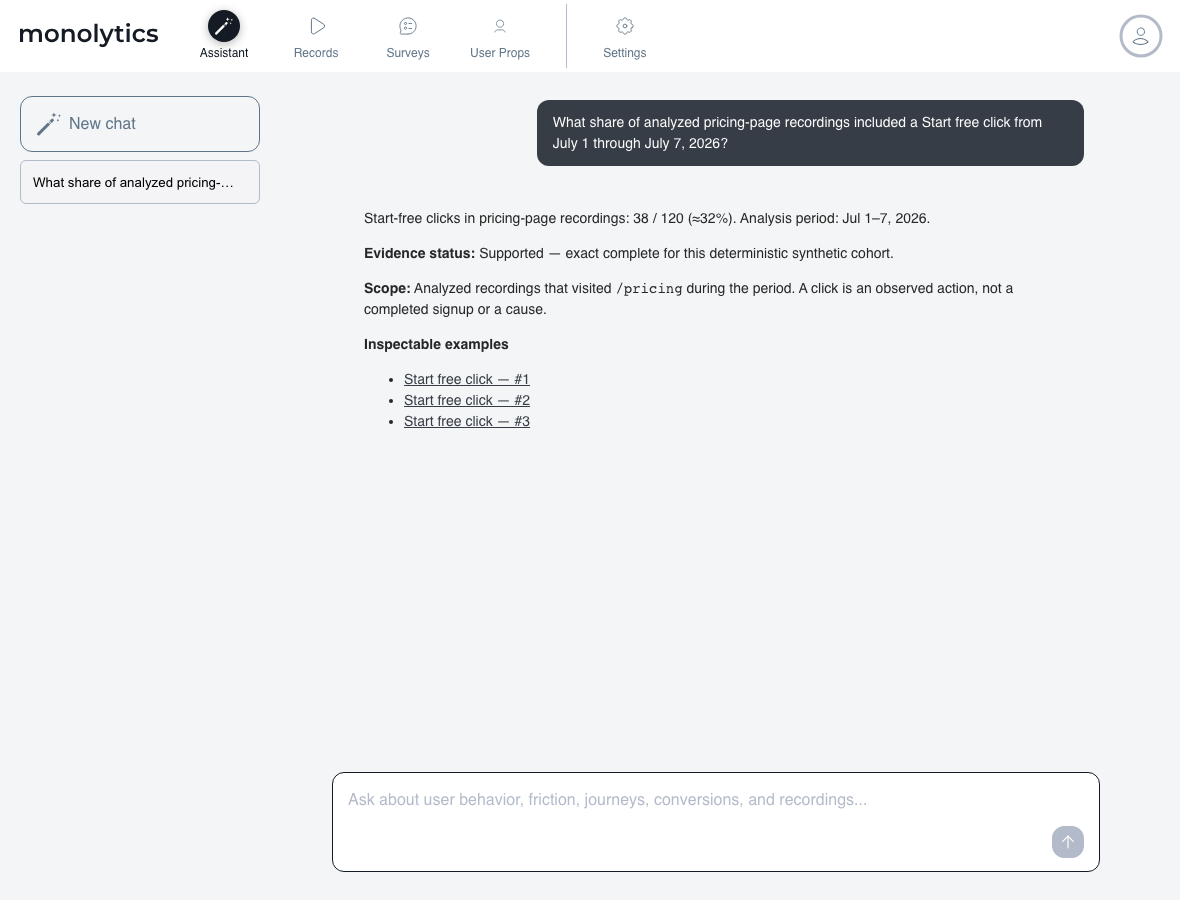
Review:
- whether each session matches the intended segment;
- what happened before and after the flagged moment;
- whether successful sessions show the same behavior;
- whether the issue repeats across comparable sessions;
- whether the wording stays behavioral;
- whether the finding needs a survey, instrumentation task, bug report, or design change;
- whether privacy and access rules allow the session to be shared.
When the output is only a plausible lead, use the session replay evidence confidence matrix before prioritizing a fix.
How Monolytics fits
Monolytics helps teams ask replay-backed product questions without starting from a random queue of recordings.
Use Monolytics natural-language Record Search when the question needs repeated patterns across many sessions. Use Records when the page, event, source, or failed path is already known. Use targeted surveys when replay shows behavior but the reason is still unclear.
For the product path, see how Monolytics helps teams surface bug and UX issue candidates from session replay. If the team is evaluating plans, compare Monolytics pricing.
Related guides
- AI session replay analysis workflow for the parent evidence-first AI replay process.
- Session replay assistant prompts for product teams for reusable prompt patterns once the product question is clear.
- Session replay summaries vs evidence review when the team needs to decide whether a summary is enough.
- When not to trust AI session summaries when the assistant answer sounds more certain than the evidence.
- Privacy-safe AI session replay analysis before asking Assistant about sensitive flows.
- Session replay AI vs manual review when the team needs to decide what AI should triage and what humans should inspect directly.
- Session replay evidence review template for documenting the final finding.
- AI session replay analysis checklist for checking whether an answer is strong enough to act on.
Session replay assistant questions FAQ
What should I ask a session replay assistant?
Ask for a specific journey, failed outcome, observable behavior, segment, and verification step. For example, ask for signup visitors who started a form, hit validation, and abandoned before submit instead of asking why conversion is down.
What questions should I avoid?
Avoid asking the assistant to decide exact user motive, frustration, root cause, roadmap priority, willingness to pay, or guaranteed conversion impact. Those questions need human judgment and supporting evidence beyond replay.
How do I know whether an assistant answer is strong enough?
Check whether the returned sessions match the intended segment, whether the pattern repeats across comparable sessions, whether successful sessions look different, and whether the finding is supported by another signal or still only a lead.
Final takeaway
The best session replay assistant questions are not magic prompts. They are careful product questions: journey, failed outcome, observable behavior, segment, and verification step.
Ask that way, and AI-assisted replay review becomes a focused evidence workflow instead of a confident answer to a vague question.